
Petra on the Galápagos Islands
Part 1: A dream come true
The time has come! That’s the first thing that springs to mind when I wake up early in the morning at the Hotel del Parque, a lovely hotel in Guayaquil, Ecuador. As soon as I step out of my room, I can immediately feel that I’ve arrived in a tropical climate. Over the past few days, I’ve mainly been travelling through the Andes, and yesterday I arrived in Guayaquil to begin a new adventure. A dream I’ve had for years is finally coming true; next week I’m visiting the Galápagos Islands!

A warm welcome
After breakfast, we’re taken to Guayaquil airport. Here we meet a friendly member of staff from Ecoventura, the cruise line with which I’ll be exploring the Galápagos Archipelago over the coming days. As soon as we leave Guayaquil, we fly over the Pacific Ocean and I realise we’re heading for an archipelago that’s far removed from everything – it’s quite special. During the flight, we’re shown a nice little film explaining the rules of the Galápagos.
We’re welcomed by our nature guides, Yvonne and Gustavo. Together, we travel with the group in a small minibus to the harbour at Puerto Baquerizo Moreno. Here, I already spot the first signs of wildlife. We’re greeted by seals, and bright orange crabs are scurrying amongst the rocks.


The MV Origin
Once we arrive at the ship, we are welcomed by the General Manager of our cruise, Jennifer, also known as Jenny. Whilst our suitcases are taken to our cabins, we are given a brief explanation of the ship and how everything works. We are then shown to our cabins. The MV Origin comprises 10 spacious cabins (approx. 13.5 m²), all situated on the same deck. The cabins feature a double bed or two single beds and a large window offering a good view of the sea.

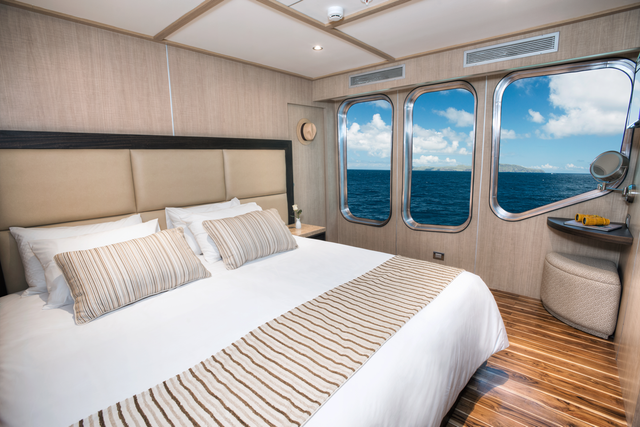
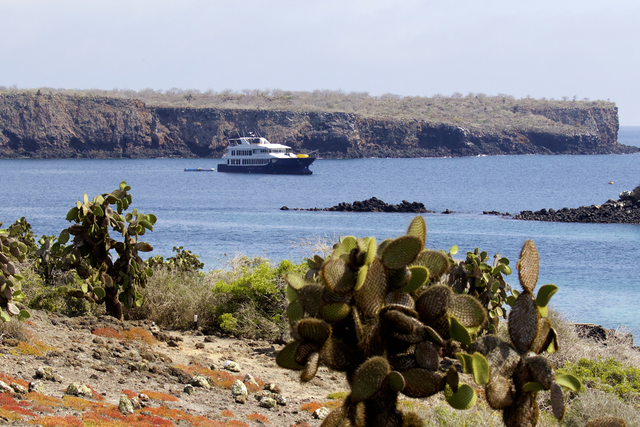
This is the first time I’ve spent any length of time on a ship. The ship isn’t big, which makes it a bit less stable at sea. My sense of balance will need a bit of time to get used to this. Fortunately, by the evening I’ll find that I’ve already got used to it a bit more, and a little while later it won’t bother me at all.
A first glimpse of the Archipelago
After lunch, we’ll be taken straight away for our first introduction to one of the many unique islands in this archipelago. We’ll have what’s known as a ‘dry landing’ at Puerto Baquerizo Moreno. The terms ‘dry landing’ and ‘wet landing’ are commonly used here. They indicate whether we arrive on the island we are visiting with our feet dry or wet. From Puerto Baquerizo Moreno, we’ll be taken by bus to the freshwater lagoon of El Junco.
El Junco is the crater of an extinct volcano. With a surface area of 60,000 m², the lagoon can hold up to 360,000 m³ of water. The lagoon is fed solely by rainwater. As a result, the water level can drop by between 1 and 3 metres during the dry season. During periods of heavy rainfall, however, the crater can actually overflow.
To reach the lagoon, we have to climb a short distance along a narrow path. Once at the top by the lagoon, we feel the wind in our hair. It’s a bit misty, so we can’t enjoy the view to the full, but it still feels very special to be here. Our guides know the area well and tell us more about the birds that visit here, such as the Galápagos tyrant. As well as knowing the area well, they’re also very committed and so tell us more about some of the problems the area is facing. One example is the introduction of new plant species due to the influx of tourists. Unintentionally, for example, seeds and pollen are carried to the islands by humans, causing new plants to grow. However, these plants are difficult to control and can, unfortunately, disrupt the ecosystem.
They also explain the difference between the terms ‘native’ and ‘endemic’. We’ll be using these words a lot over the coming days. ‘Native’ means that something occurs naturally in a particular area, in other words, without human influence. This applies to both fauna and flora. ‘Endemic’ means that a particular species occurs naturally only in a specific area. For example, a particular bird species may be native to the Galápagos Islands and endemic to a specific island.


A successful first day
After visiting the lagoon, we return to our ship. Following a hot shower, we are expected in the lounge area of the MV Origin for a briefing on the following day’s programme. We are told what the programme will involve and are given a sneak preview on the screen.
After the briefing, it’s time for a welcome dinner with the ship’s captain. The MV Origin is currently the only cruise ship affiliated with Relais & Châteaux, so we’re certainly in for a culinary treat. Whilst we enjoy an excellent dinner and a lovely evening’s company, we sail on in a north-easterly direction towards Punta Pitt for tomorrow’s adventure!
Day 2: A visit to Punta Pitt and Cerro Brujo
It takes a bit of getting used to sleeping on a boat, but fortunately most people (including me) slept well. After the extensive breakfast buffet, we get to try on our snorkelling gear for the coming days and get it ready. After that, it’s time for our first ‘wet landing’. We set off in the pangas towards Punta Pitt beach. We climb out of the panga and wade through the sea to the beach. Here, we have to wipe the sand off our feet and put our shoes back on for a walk to the top.
Curious San Cristóbal polishers and the Sally Lightfoot crab
We walk along a beach that looks almost pearly white, but nothing could be further from the truth. Our nature guide, Gustavo, scoops up a little sand in the palm of his hand and we soon see that it is greenish in colour, due to the mineral olivine. We look around and admire the deserted beach. Before long, a San Cristóbal spotted thrush approaches us curiously; this is a bird species endemic to the island of San Cristóbal. The rule about keeping a 2-metre distance from animals is difficult to follow here. The little birds simply come right up to us and almost look us in the eye. The guides ask us to stay calm, watch our step carefully and, above all, enjoy seeing the little birds approach us. Personally, I didn’t think I was particularly interested in birds; of course, I’d always found it special to see toucans, macaws, flamingos and so on, but now that I can get so close to this little bird, I find it a truly special experience.

We walk along a path towards the top of the island; now and then we spot a lizard amongst the rocks. There isn’t much shade, so the sun’s rays are beating down on my head. Fortunately, there is a lovely sea breeze. We reach a lovely viewpoint, from where we can see our cruise ship moored. Along the way, we spot no fewer than three different species of gannet (the blue-footed gannet, the red-footed gannet and the Nazca gannet) and two species of frigatebird. Due to the drought on the island, many bushes look ‘dead’. In fact, these shrubs shed their leaves and turn grey during the dry season to keep themselves alive. Yet here and there we also see plants with a beautiful red colour that is almost reminiscent of coral, and yellow-coloured leaves.
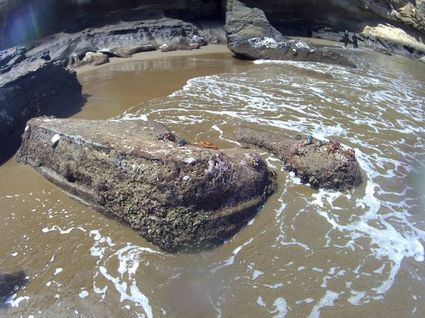
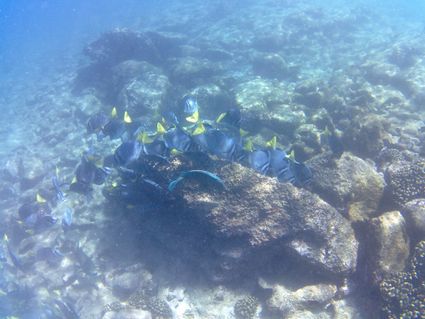
After taking in the sights here, we return to the beach where we come across brightly coloured Sally Lightfoot crabs (Grapsus grapsus). We’re taken back to the ship where we can collect our snorkelling gear and go snorkelling for the first time in the waters of the Galápagos. Before we dive into the water, we spot a lava gull, which looks a bit like a pigeon. Once in the water, I get up close to a curious seal and see various fish, such as the Holacanthus passer and a large colony of surgeonfish. Before returning on board our boat, we take a stroll along the beach. A seal is dozing on a rock and, as soon as we walk past, it waves its flipper affectionately, as if to say hello. A beautiful sight.
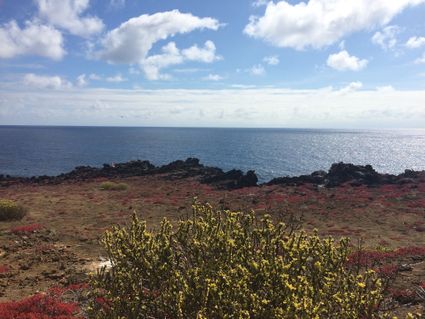
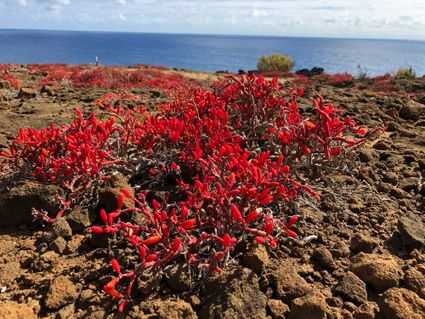
Seals at Cerro Brujo
Whilst I’m having a hot shower in my own cabin, the crew are already busy preparing lunch. As lunch is served, we sail on towards Cerro Brujo. After our siesta, we board the panga again and sail through a large opening in the rocks. This spot is also known as ‘the cathedral’. Here, too, we spot a few birds, including pelicans. It seems almost impossible to sail through the rocks, but our captain skilfully steers us through. We then reach the white coral sand beach of Cerro Brujo via a wet landing. Once again, we are the only visitors on this deserted beach. We come across dozens of seals, some dozing peacefully on the beach, whilst others are pups seeking milk from their mothers. After thoroughly enjoying the beach and its friendly inhabitants, we return to the ship by panga.


Fancy visiting the Galápagos Islands?
Would you like to visit the Galapagos Islands yourself and are you curious about the options available? Then do take a look at the tours we’ve put together for inspiration. You can book these tours directly, but we’d also be happy to put together a personalised itinerary based on your wishes and ideas.
Do you have an immediate question? Then feel free to contact us. Call +31 73 610 62 04 or send an e-mail to info@sapapanatravel.nl. We are happy to help.